
 The BMT Guarantee
 Residential case study
 Commercial case study


What is a depreciation schedule?
What is a depreciation schedule?
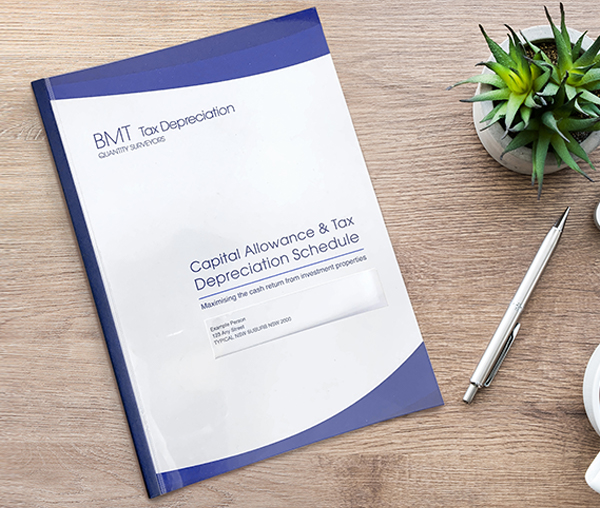
A depreciation schedule is a comprehensive report that outlines the potential tax deductions available on an investment property. By calculating the decline in value of a property's building structure (capital works) and assets (plant and equipment) over time, property owners can claim these deductions annually. These deductions can significantly reduce taxable income and increase overall returns.
To obtain a depreciation schedule, engaging BMT to assess your property and prepare a detailed report is crucial to ensure you are claiming the maximum return on your investment property from qualified quantity surveyors.
A BMT depreciation schedule includes:
- A detailed 40-year forecast illustrating all depreciable assets available for the life of the property
- The effective life and depreciation rate for all division 40 (plant and equipment) assets, e.g. hot water systems, air conditioning units, blinds and curtains etc
- Division 43 (capital works) deductions e.g. built in cupboards, sinks, driveways
- Depreciation methods: Both prime cost and diminishing value are included to help you decide which depreciation method is best for you
- A glossary of terms to help you understand the terminology used throughout the schedule
- Excel and CSV files (residential only) can be provided for accountants and owners to easily import the depreciation schedule with compatible accounting software
In addition
- A pro-rata calculation can be provided when a residential investment property is acquired part way through a financial year or rented for only a percentage of the year, ensuring that deductions are accurately maximised; and
- Split depreciation schedules are also available when residential investment properties are owned by more than one person, often resulting in higher deductions earlier.
BMT Tax Depreciation's CEO, Bradley Beer, discusses the benefits of a depreciation schedule for your residential investment property.
Your customised schedule will project capital works deductions and plant and equipment depreciation for the life of the property. This
depreciation can be claimed in your tax return each financial year to help you save thousands.
Benefits of a depreciation schedule

Great deductions
We find residential clients an average of over
$12,000 in first full financial year
deductions.

Lasts a lifetime
Your schedule lasts a lifetime
and the one-off fee is 100%
tax deductible.

Claim back missed dollars
You can use your BMT schedule to
adjust previous tax returns and claim
back missed dollars.
When do I need to order a depreciation schedule?
When do I need to order a depreciation schedule?
The optimal time to order a depreciation schedule is once your property has become genuinely available for rent. This ensures that we have the most accurate valuations as possible, as well as the property meets the guidelines for claiming tax depreciation.
However, you can claim missed depreciation deductions on your investment property for at least two years after purchase.
The cost of your depreciation schedule can also be claimed, which can also help you reduce your taxable income further in the financial year it was paid for.
Renovations
For substantial renovations, such as removing and rebuilding entire sections of your investment property, you may also need a new depreciation schedule.
For cosmetic renovations such as renovating a kitchen, retiling a bathroom or replacing a hot water system, an update to your current schedule will suffice. BMT Tax Depreciation can easily make updates to their existing schedules to ensure any addition or renovation is included where depreciation is concerned.
In either case it is best to contact us before commencing renovations as we are happy to provide recommendations and guidance into what will help you to maximise depreciation deductions based on your individual circumstances.
Residential and commercial depreciation examples
Residential and commercial depreciation examples
Here are some examples of typical depreciation amounts found by BMT Tax Depreciation based on the diminishing value method of depreciation. For further examples visit our case studies page.

| Residential investment property | |||
| Building type | Purchase price | Year 1 depreciation | Year 1 - 5 cumulative depreciation |
|---|---|---|---|
| 1 bedroom unit | $450,000 | $9,000 | $41,000 |
| 2 bedroom unit | $500,000 | $12,000 | $52,000 |
| 3 bedroom unit | $620,000 | $15,000 | $63,000 |
|
Townhouse
|
$480,000
|
$8,000
|
$40,000
|
| Townhouse | $550,000 | $11,000 | $51,000 |
| Residential house | $500,000 | $11,500 | $53,000 |
| Residential house | $600,000 | $13,000 | $55,000 |

|
Commercial / Industrial investment property |
|||
| Building type | Purchase price | Year 1 depreciation | Year 1 - 5 cumulative depreciation |
|---|---|---|---|
| Strata office | $750,000 | $31,000 | $127,000 |
| Office building | $1,000,000 | $40,000 | $165,000 |
| Office building | $2,500,000 | $95,000 | $390,000 |
| Office building | $10,000,000 | $390,000 | $1,600,000 |
| Warehouse | $30,000,000 | $1,100,000 | $4,500,000 |
| Nursing home | $16,000,000 | $550,000 | $2,500,000 |
| Retail shop | $1,000,000 | $42,000 | $170,000 |
What sets a BMT Tax Depreciation
Schedule apart?
What sets a BMT Tax Depreciation Schedule apart?

Maximum deductions
We leave no stone unturned in order to find you every deduction available.

Australia wide service
We will complete your depreciation schedule no matter where your property is located.

Split schedules
We provide split depreciation schedules on co-owned properties to maximise deductions.

Site inspections
We use our own staff to conduct inspections rather than outsourcing.

The BMT Guarantee
We guarantee to find double our fee in deductions in the first full financial year claim or there will be no charge for our services.
How do I claim depreciation?
How do I claim depreciation?
Arranging a BMT Tax Depreciation Schedule couldn’t be easier.
1: Get a Quote
Find out how much your depreciation schedule will cost by requesting a quote.
2: Provide details
We’ll collect property details then contact your property manager or tenant to arrange access for one of our specialist staff to complete a property inspection.
3: Claim deductions
Your depreciation schedule will be ready within 7 days of receiving all information. We can even forward it to your accountant to save you time.
FAQs about depreciation schedules
FAQs
FAQs about depreciation schedules
What areas do you cover?
Do you inspect properties?
Is my property too old to claim tax depreciation?
It is a common myth that older properties will attract no depreciation claim. However, both new and old properties will hold some depreciation benefits.
A depreciation schedule is the best way to ensure the biggest tax refund possible. A BMT Tax Depreciation Schedule covers all deductions available over the lifetime of a property.
Doesn't my accountant already take care of this for me?
BMT Tax Depreciation works with your accountant to ensure that your depreciation claim for your investment property is maximised each financial year. The ATO states in taxation ruling 97/25 that quantity surveyors such as BMT Tax Depreciation are one of the only recognised professions with the appropriate construction costing skills to estimate construction costs for depreciation purposes.
Why does a BMT Tax Depreciation Schedule last for forty years?
What information do I need to provide?
- Your settlement date
- Purchase price
- Contact details for your property manager or tenant to organise the site inspection
- Information on improvements or additions made to the property
- The date the property become income producing
Do I need a new depreciation schedule each year?
You only need one tax depreciation schedule per investment property. We recommend you get your schedule soon after settlement to ensure that you’re claiming the maximum deductions straight away.
If you make significant changes to your property, you may need to update your schedule.
I need another copy of my schedule – can you provide this?
How to use a BMT Capital Allowance and Tax Depreciation Schedule
Simply provide your accountant with your BMT Tax Depreciation Schedule to start claiming maximum deductions. We can also liaise with your accountant and provide the report directly. Just let us know when you order your schedule and we’ll be happy to help.
How to use a BMT Capital Allowance
and Tax Depreciation Schedule
Simply provide your accountant with your BMT Tax Depreciation Schedule to start claiming maximum deductions. We can also liaise with your accountant and provide the report directly. Just let us know when you order your schedule and we’ll be happy to help.